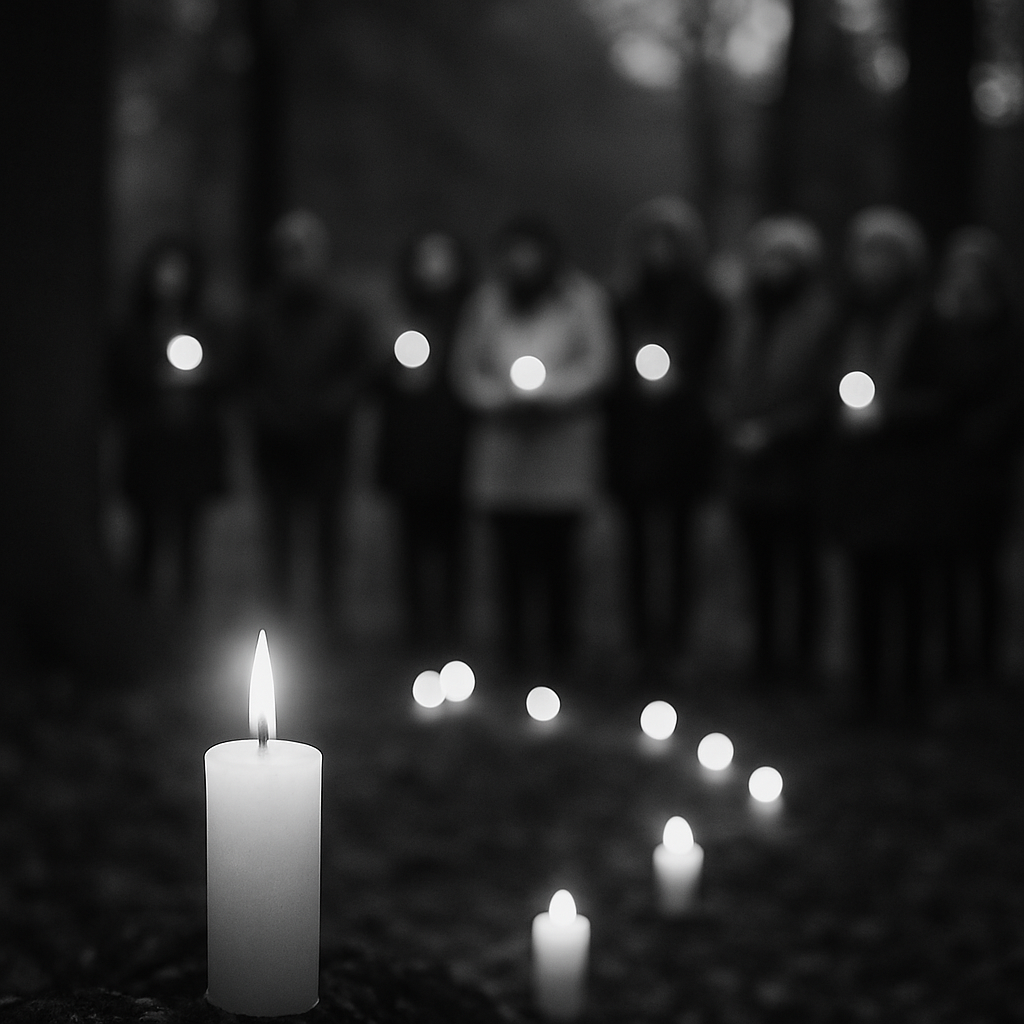
“Justice begins with memory.”
Equal Justice Initiative
In America, the murder of Black men is too often met with silence—or worse, with dismissal.
When a Black man is found dead, hanging from a tree, there should be no assumption of suicide. There should be no rush to wrap the case in procedural neatness, no comfortable narratives, no swift closing of files. There should be questions. There should be transparency. There should be truth.
And yet, here we are.
In 2025, lynching is still happening. It is not met with the spectacle of postcards and mobs. Nonetheless, it continues with the same deadly silence from institutions. There is the same disbelief from grieving families. The same historical weight has never truly lifted.
We were told it was suicide.
We do not believe them.
Because history remembers otherwise.
Say Their Names
We start by saying their names. Not as a footnote. Not as a statistic. As people.
Javion MaGee
- Date: September 11, 2024
- Location: Vance County, North Carolina
- Age: 21
- Details: Javion was a young Black truck driver from Illinois. He was found with a rope wrapped around his neck near a tree. The police stated the death was a suicide. A coroner’s report also ruled it a suicide. Nevertheless, his family has pushed for an independent autopsy. They cite inconsistencies and historical context.
- Source: Capital B News
Earl Smith
- Date: June 11, 2025
- Location: Albany, New York
- Age: 51
- Details: Earl was found hanging from a tree on Westerlo Street. Police stated there was no evidence of foul play. But, public concern has grown because there is a pattern of Black men found dead under similar circumstances. An investigation is ongoing, and the community has voiced strong distrust toward early conclusions.
- Source:Times Union Article
Malcolm Harsch
- Date: May 31, 2020
- Location: Victorville, California
- Age: 38
- Details: Malcolm was found hanging from a tree near a library. His death raised national concern, especially due to its proximity to Robert Fuller’s death. Though surveillance later confirmed suicide, his family emphasized their response was rooted in historical trauma and a wish for transparency.
- Source: New York Times
Robert Fuller
- Date: June 10, 2020
- Location: Palmdale, California
- Age: 24
- Details: Robert’s body was discovered hanging from a tree in a public park. National protests followed. After review, officials ruled his death a suicide. His family accepted the findings. They stressed the importance of open dialogue on Black mental health. They also highlighted the history of racial terror.
- Source: NPR
Lennon Lacy
- Date: August 29, 2014
- Location: Bladenboro, North Carolina
- Age: 17
- Details: Lennon, a promising football player, was found hanging from a swing set. Officials ruled it suicide. But, his family noted inconsistencies. They pointed out mismatched shoes, signs of physical injury, and social tensions over his interracial relationship. Civil rights groups called for a federal investigation.
- Source: Essence
These men were not anomalies. They were loved. They mattered. And the manner of their deaths—eerily familiar to centuries of terror—demands more than quiet reports and clinical phrases. It demands remembrance, outrage, and the full weight of historical context.
We say their names because forgetting is a form of violence, too.
A Pattern We Know All Too Well
When news breaks of a Black man found hanging from a tree, many Americans still ask, “What happened?”
But for Black families—especially in the South—the reaction is often different. It’s not a question of what, but why, and how long until they tell us it was suicide again?
Because we’ve seen this pattern before.
- The official statement comes fast. It often arrives before autopsies are finished. It is released before families are informed. It is long before any transparent investigation takes place.
- The word ‘suicide’ is issued like a shield, a rhetorical closing of the case before it’s truly opened.
- The public is expected to move on.
Quietly. Politely. Complicitly.
But the families of Javion MaGee and Earl Smith are not quiet. Neither are those who remember names like Malcolm Harsch, Robert Fuller, or Lennon Lacy. They were all Black men found hanging in public places. Each case was ruled a suicide under deeply contested circumstances.
In MaGee’s case, surveillance footage was cited as “proof” of intent. Yet his family was quick to point out: as a truck driver, rope is part of his job. His body was not found hanging, but against a tree. His family describes being denied access to identify his body. Officials told them that its “state” was too upsetting to view.
In Earl Smith’s case, public details remain scarce. He was found in Albany, New York—one of the oldest and most segregated cities in the Northeast. His name became known through a viral TikTok video. Social media whispers mentioned yet another lynching.
This isn’t unfamiliar grief. This is historical grief in real time.
The public is told there’s no noose.
No foul play.
No reason to suspect anything.
But families, communities, and civil rights organizers understand the coded language and the chilling familiarity. This is a legacy of racial terror lynching, and the pattern isn’t just historical—it’s generational.
Lynching Didn’t End—It Mutated
Lynching is often spoken of in the past tense. It is tucked into sanitized history books. It is remembered only through grainy black-and-white images of nooses and trees. But lynching did not end when the postcards stopped being printed. It didn’t end when Jim Crow was struck down on paper. It didn’t end when public hangings became too shameful for the evening news. It mutated.
Today, lynching hides in plain sight. It is disguised as “suicide.” It is distorted by official reports and dismissed by those who benefit from silence. It has become a quiet killing. It is a headline buried on page six. It is a life explained away with bureaucratic detachment and gaslighting grief.
Black men found hanging from trees are still met with police statements of “no foul play.” Families are told not to believe their instincts. The trauma is doubled — first in the death, then in the public erasure.
The Equal Justice Initiative documents more than 6,500 known racial terror lynchings between 1865 and 1950. But the number doesn’t stop there. It continues, reshaped by new tools. These tools include systemic neglect, medical racism, and algorithmic bias. There is also the silent complicity of institutions. They treat these deaths as anomalies instead of echoes of a bloody legacy.
Modern lynchings are not accompanied by mobs with torches. However, the spirit of racial terror is alive. This is evident in the disproportionate police shootings. It also appears in the so-called suicides that echo the iconography of hate. The refusal to even name them as what they are reinforces this terror. These are acts of violence fueled by the belief that Black lives are expendable.
Even when not fatal, the fear is there. It is a generational trauma. It is embedded in the DNA of communities. They’ve been taught that freedom comes with a condition: don’t be too visible. Don’t be too loud. Don’t trust that justice will come for you.
As civil rights leader Bishop William Barber II said, “Hanging is not a form of death that can be easily dismissed, particularly here in the South, where it has been used as a weapon of terror against Black families for generations.”
We must say plainly: Lynching is not over. It has evolved.
The Long Shadow of Racial Terror
The legacy of lynching did not vanish with the passing of civil rights legislation or the shuttering of Jim Crow. It seeped into the soil. It echoes in the generational trauma carried by Black families. It carved scars into the landscape of America that are still visible today—if we dare to look.
A new study from the University of South Florida found that counties in the South with the highest number of racial terror lynchings now have the lowest life expectancy. The gap is small in number—about one year—but devastating in implication. The researchers found that the presence of lynchings correlated not only with shortened lives. It was also associated with higher unemployment, deeper poverty, wider income inequality, and diminished access to healthcare.
In counties with no recorded lynchings, the average life expectancy was 76.6 years. In counties with a known history of lynching? 75.5. One year seems small to some—but it represents thousands of lost days, thousands of unfinished stories. It is not an accident. It is the residue of racial terror.
These numbers expose how white supremacist violence didn’t just kill individuals—it reshaped the social and physical environments of entire communities. Health outcomes today are still dictated by the geography of fear. They are also influenced by the silence of justice and the lingering absence of the people who never came home.
The South bears the brunt of this shadow, but it is not alone. This trauma travels. It rides in the bloodstream of systemic neglect. It shows up in underfunded schools, shuttered clinics, and food deserts. It appears in headlines about police brutality. It disappears in the back pages of medical studies that never make the news.
The Equal Justice Initiative reminds us: “The trauma of lynching is not a relic of the past—it is an inherited grief that Black Americans are still being asked to carry, in silence, and without justice.”
We cannot continue to treat these deaths as disconnected events. They are part of a pattern. A long shadow. A chain. And unless we name the links, they will keep being forged in the dark.
Say Their Names. Break the Silence
We cannot change what has already happened. But we can decide what happens next. We can choose if these men’s names fade into a whisper. Alternatively, we can ensure they are carved into the walls of memory. They serve as reminders, warnings, and sacred truths.
Javion MaGee. Earl Smith. Malcolm Harsch. Robert Fuller. Lennon Lacy.
Say their names. Learn their stories. Honor the lives that were taken.
They were more than headlines. They were more than hashtags.
They were human—and they deserved to grow old.
Lynching has never been just about rope or trees. It has always been about control. About fear. About silencing. About reinforcing white supremacy through acts of terror so horrific that entire communities would fall into generational grief.
To call it anything else is to take part in that silencing. To call it mere coincidence, or mental illness, or self-inflicted without full, independent investigation is wrong.
And should be refused.
We are not just telling stories. We are confronting history.
We are not just remembering. We are resisting.
We are not just writing. We are naming the violence—and we are naming the dead.
Because silence protects power. And truth, told aloud, shakes the roots of that power loose.



Leave a Reply