

In the days when the sun was heavy with gold,
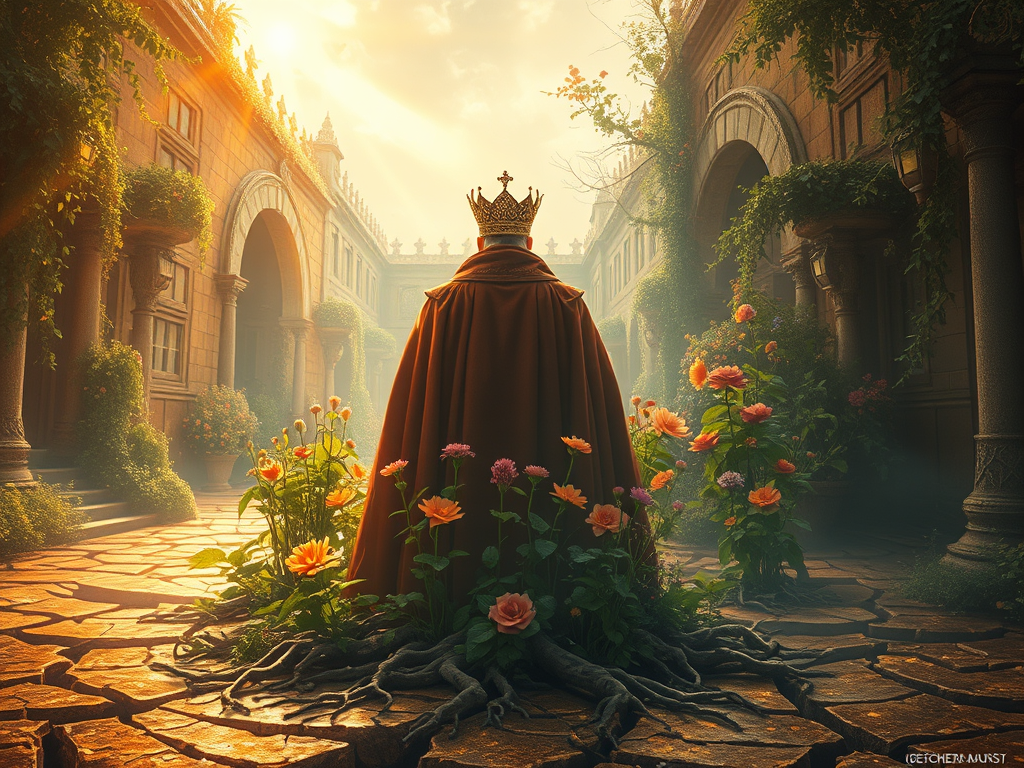
there ruled a King who hated the earth.
Not all the earth, mind you —
only the parts that refused to kneel.
He wore crowns hammered from sunrise,
robes stitched with the skins of autumn,
and he covered his streets in shining plates
so no one could see the dirt beneath.
“Roots,” he said,
“are snares for the unwary.
They rise without permission,
tangle themselves in the feet of honest folk,
and make a mockery of my perfect ground.
They must be gone.”
So he called forth the Shovels,
and the Blades,
and the men whose pay was heavy
and whose hearts were light,
and he sent them to dig out every root
from the stones to the riverbank.
But the roots…
ah, the roots were older than his coins,
older than his crown,
and they knew the trick of growing sideways,
deep and low,
beneath the notice of gilded eyes.
And so the Shovels dug,
and the Blades cut,
and the King’s streets gleamed brighter than ever before.
The sun struck them so fiercely
that the air above them shimmered and swayed
like a drunk at a harvest feast.
But down in the cool dark,
the roots whispered to one another.
They sent messages through soil and stone,
not with words, but with water,
passing secrets in slow sips.
“They think we are gone,”
murmured the willow roots to the maple.
“They think the gold above is stronger than the green below,”
sighed the dandelion threads to the stubborn oak.
And together,
they began the old work.
They did not rush.
Roots never rush.
They curved under walls,
curled through cracks,
and pressed against the shining plates of the King’s streets
until—
pop!
a seam split.
At first it was nothing,
a sliver of shadow in the gold.
But the shadow drank rain,
and the rain fed the roots,
and the roots fed the crack,
and the crack grew wide enough
for a seed to see the sky again.
The seed woke.
It pushed a tender green shoot into the sunlit air,
shaking off the last crumbs of darkness.
The King, passing by in his chariot of polished brass,
saw it.
“Ugly thing,” he said,
“and dangerous—someone might trip.”
He ordered the Shoemakers of the Street
to hammer the gold back down.
But roots do not forget.
And rain is not loyal to kings.
The next season,
three shoots came.
The next, seven.
By the fourth year,
a garden had cracked open the street like a loaf of bread,
steam rising in the morning sun.
The people noticed.
Some knelt to touch the blossoms,
to smell the mint,
to pluck a strawberry that had grown
right where the King once stood to declare their removal.
The King ordered the Blades to return.
But the Blades broke on oak knots.
The Shovels bent against the stones.
The gold plates warped in the summer heat,
their shine dulled under footprints and petals.
In the end,
the roots were not gone—
they had simply been waiting.
And so the hidden garden grew,
fed by stubborn green and quiet defiance,
until the streets were no longer the King’s to gild.



Leave a Reply